How much wallpaper do I need? Pattern repeat explained
Count full drops, read the pattern match on your roll, and check how trim and alignment change what you can cut from each roll.
Wallpaper calculator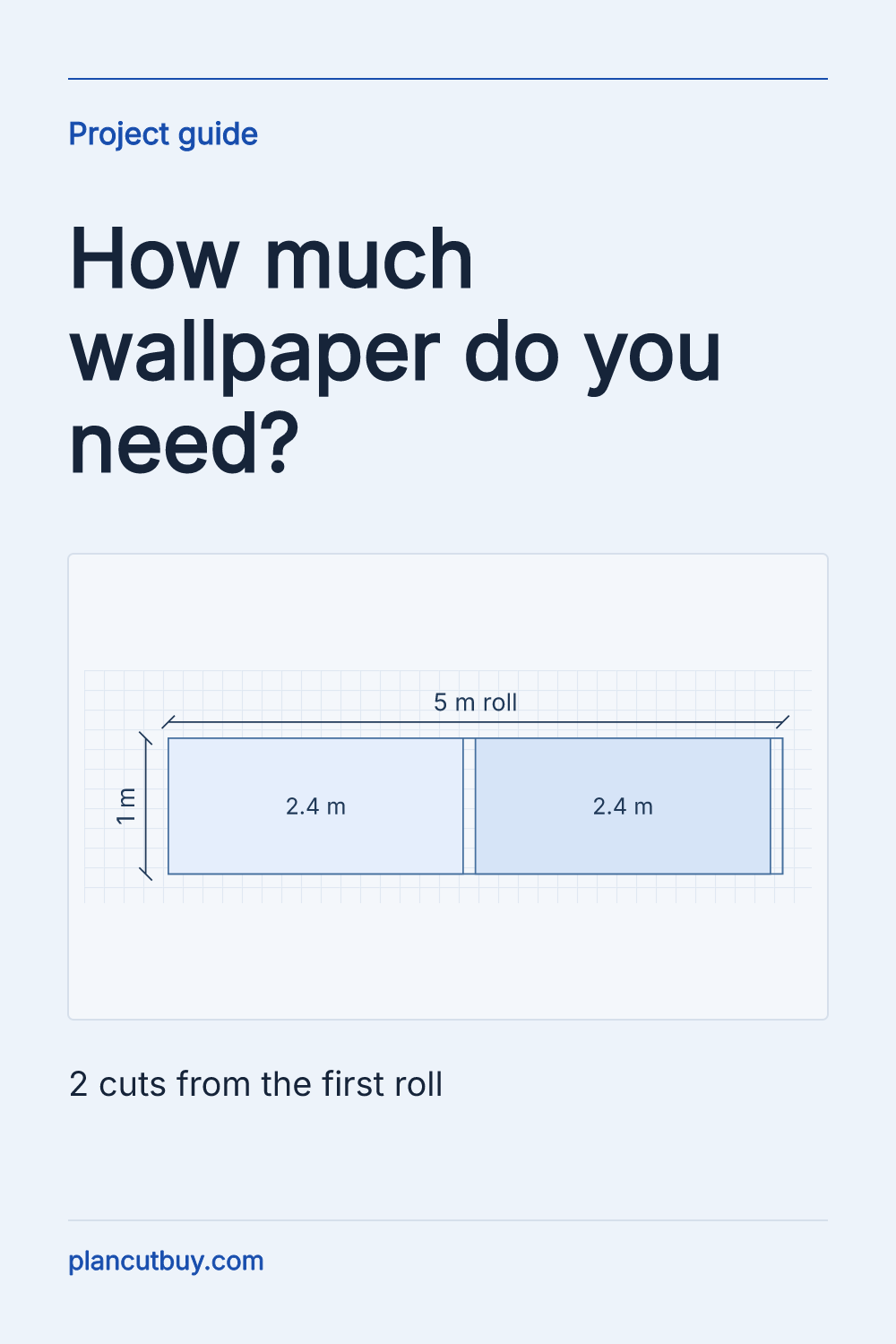
To estimate wallpaper, count the vertical strips that cover each wall, then work out how many of those strips you can cut from a roll. The same roll can cover different amounts of wall depending on the ceiling height, the trim at each end and the amount of paper you have to skip to line up the pattern. The wallpaper calculator uses those dimensions and shows where each piece starts on the roll.
Measure the wall in strips
List the width and height of each wall you plan to paper. Check height at both ends and in the middle. Where the ceiling or skirting varies, measure the tallest part each planned strip must cover. If the variation is small, using the highest measurement for the whole wall keeps the estimate simple. Add the top and bottom trim specified for your paper and installation. Where the trim is equal at both ends, enter it once as trim per end.
Check the usable roll width. If the instructions call for trimming a selvedge before hanging, base the count on the width that actually covers the wall. Divide the wall width by that usable width and round up to the next whole strip. The last position may be narrow but can still use a full-length blank. Sketch the seams first if you want a motif centred on a chimney breast or want to avoid a narrow strip beside a prominent corner. A shifted starting position may change the count compared with beginning at one edge with a full-width strip.
Confirm the dimensions of the product you will receive. When a listing prices paper in single rolls but ships a longer packaged roll, use the dimensions of the continuous roll for cutting and check how the shop counts what you order. The length available for a full drop is the uninterrupted physical length. If other walls will be painted, estimate those surfaces separately with the paint calculator.
Read the repeat and the match on the label
The repeat is the distance down the roll between two identical points on the design. The match tells you where that point belongs on the next strip. With free or random match, there’s no alignment skip between strips for matching the motif. Follow the label for hanging direction. With straight match, adjacent strips start at the same point in the repeat so the motif lines up across the seam. A drop match shifts that point vertically on the next strip. A half drop shifts it by half a repeat, while a third drop can require a three-strip sequence. Enter the stated offset if it differs from half a repeat. See Cole & Son’s guide to pattern matching.
To check a label against the paper, unroll enough to spot the same point twice. Pick a precise feature, such as the tip of a leaf. Measure parallel to the edge of the paper. Then check how the feature lines up at the joining edge with the neighbouring strip. With patterned paper, mark the hanging order and top of each piece on the back. If you swap the order of two drop-match strips, the seams can fail to line up even though the pieces are long enough.
Worked example with a straight match
Take a 2 m wide by 2.3 m tall wall (about 78.74 in by 90.55 in). The example roll is 1 m wide and 5 m long (about 39.37 in by 196.85 in), with a 500 mm straight repeat (about 19.69 in). The roll starts at the required pattern point and there are no openings. Allow 50 mm (about 1.97 in) at each end for trimming.
The wall needs 2 strips. Each blank is 2.4 m long (about 94.49 in). Cut the first at the roll head and stop at 2.4 m. The next start in the same phase is at 2.5 m (about 98.43 in), after 0.1 m of alignment waste. The second blank ends at 4.9 m, leaving 0.1 m at the roll tail. Both pieces fit in 1 roll. The two short unused sections are in different places on the roll, so neither is part of a continuous strip you can hang.
If the first roll starts at an unknown phase, leave the start phase unset. The calculator budgets up to one full repeat at the start of each roll. With these dimensions, allowing for that first repeat means buying two rolls. Confirming where the motif starts can change the purchase estimate. When rolls start at different points, check the first cut on each physical roll before applying a cut list that assumes the same starting phase.
Handle windows, doors and the final order
Draw each opening in relation to the planned seams. When a strip runs down one side of a window, you may still need its full height and cut out the window edge in place. Where an opening spans a whole strip column, shorter pieces may fit above or below it. The pattern at those heights still has to match the neighbouring drops. The calculator uses opening positions and strip geometry, so give it the offsets from the top and left of the wall, along with width and height.
Check how the paper wraps or joins at corners using the maker’s hanging instructions. Before ordering, confirm the true roll length, match and batch with your supplier. If you’re considering a spare, use the cut plan to see what remains in full-height pieces. A remnant long enough for a small patch might be too short to replace an entire damaged drop. If the project needs a spare roll, buy it alongside the others to improve the chance of matching the batch.
Quick answers
Frequently asked questions
Is pattern repeat the same as the drop offset?
The repeat is the vertical distance before the motif returns on the same strip. The drop offset is the vertical shift needed to match that strip to the strip alongside it.
Can I subtract the area of a window from my roll estimate?
Map the window against the strip positions. A strip that still has to run beside the opening may need a full-height blank. A complete column above or below the opening can sometimes be cut from a shorter piece with the right pattern alignment.
Try the calculator
- Wallpaper calculator
Calculate wallpaper rolls and cut lengths for free, straight and drop matches, using the position of each opening.
- Paint calculator
Calculate paint from wall and room dimensions, openings, coats, and label coverage. Compare up to three can sizes and prices.