How Much Paint Do I Need for a 10x10 Room?
See when two gallons cover a 10x10 room, how wall height and openings change the estimate, and how to check the can count before buying.
Paint calculator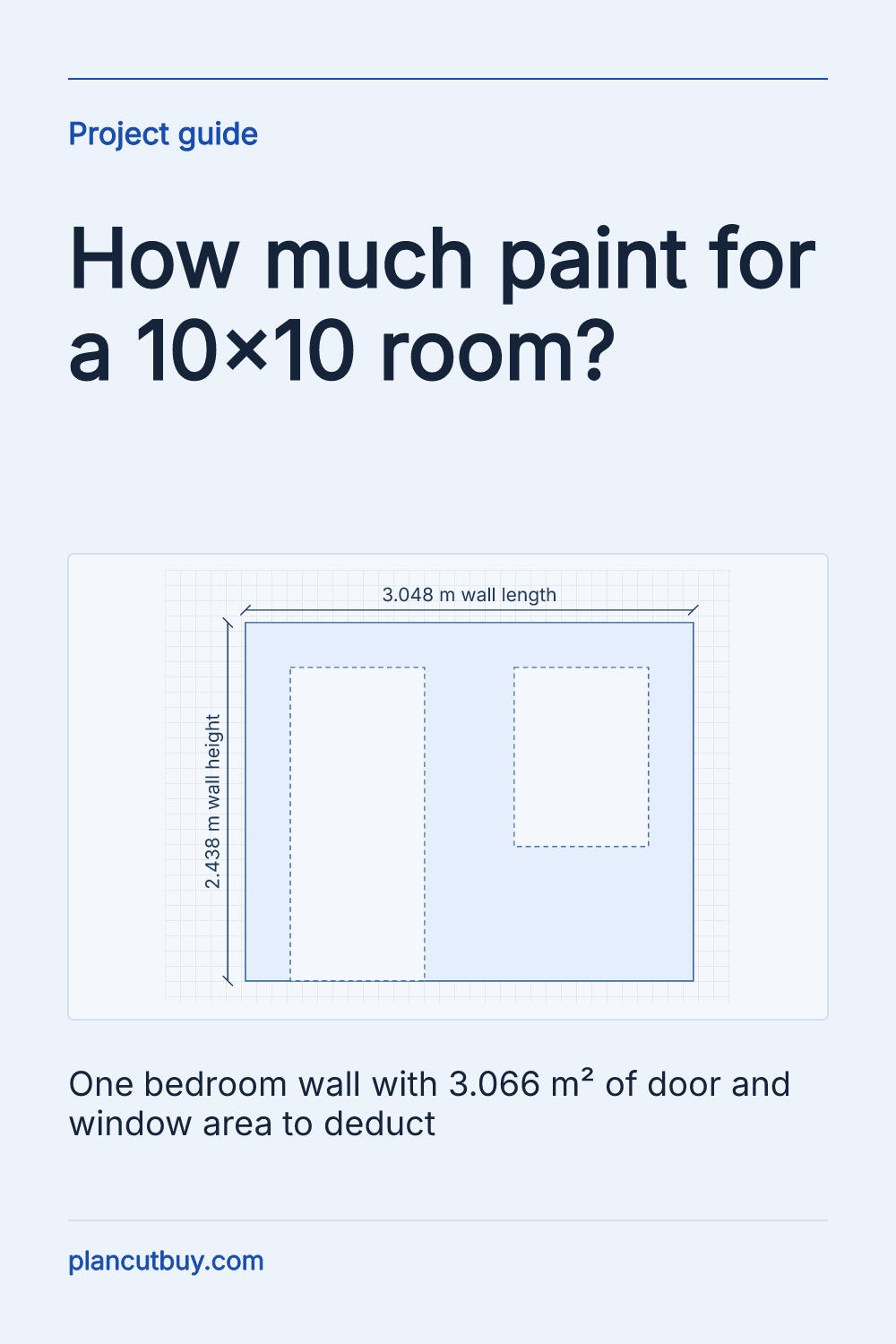
Budget two 1-US-gallon cans (about 7.57 L total) for two coats on the walls of a 10 × 10 ft room (3.05 × 3.05 m) if the paintable height is 8 ft (2.44 m), the door and window take up about 33 ft² (3.07 m²), and the paint covers about 326 ft² per US gal (8 m²/L) per coat. That purchase includes a 10% allowance under those assumptions. Measure your wall height and check your paint label before buying. Use the paint calculator to see whether your own measurements and can sizes put you over two gallons.
Measure the four walls and the openings
A 10 × 10 ft floor is 100 ft² (9.29 m²). The four walls wrap around a 40 ft (12.19 m) perimeter, so with 8 ft (2.44 m) of paintable height you start with 320 ft² (29.73 m²) of wall. Measure the inside wall lengths rather than using the dimensions from a floor plan. Take the height between the edges where the wall paint will stop, such as the top of the baseboard and the underside of the ceiling molding. If a bulkhead steps down or a wall follows a sloping ceiling, measure the affected section separately.
On a quick sketch, mark every area that the roller and brush will skip. Measure a door or window to the outside edges of its casing if the casing will get a different finish. For a door that extends below the lower paint line, count only the part inside the measured wall rectangle. If you plan to paint the recessed faces around a window, measure those narrow surfaces separately. Assign each to the paint you will use on it.
Use the square footage calculator to add opening areas. Enter the width and height of each as a rectangle and transfer the total to the paint estimate. You can also use it to measure the ceiling for a separate order. A flat ceiling adds the same 100 ft² (9.29 m²) as the floor in this example, enough to change the purchase if it shares the wall paint.
Convert wall area into cans
In the paint calculator, choose Rectangular room for four walls around a rectangular footprint with the same paintable height. Enter the opening total under Total door and window area. Use Single wall rows for separately measured wall sections. Select Include ceiling if the flat ceiling uses the same paint, coverage and coat count as the walls. Estimate a different ceiling finish, an accent colour or primer using its own coat count and label coverage.
Subtract openings from gross wall area, multiply by the number of coats, then divide by the coverage per coat. Pair square feet with coverage in ft² per US gal, or square metres with coverage in m²/L. Apply any extra allowance to that net paint volume before rounding up to the cans or combination of cans you can buy. When several surfaces share a product, colour and sheen, total their needs before rounding so each small section does not trigger its own can.
Worked example for a 10 × 10 ft room
The wall elevation shows where to measure to the paint edges. Its dashed rectangles mark a door on the left and a window on the right. The example has four 10 ft (3.048 m) walls and an 8 ft (2.4384 m) paintable height. The door deduction is 3 × 7 ft (0.9144 × 2.1336 m) and the window deduction is 3 × 4 ft (0.9144 × 1.2192 m). The door starts 1 ft (0.3048 m) from the left edge. The window starts 6 ft (1.8288 m) from that edge and sits 3 ft (0.9144 m) above the lower paint line. Those offsets place the openings in the drawing.
The openings take up 21 + 12 = 33 ft², or 3.06580032 m². Subtract them from the 320 ft² of gross wall to get 287 ft², or 26.66317248 m², per coat. This order covers the wall faces. The ceiling, door, trim and primer have separate estimates if they are part of the job.
For two coats at an example label rate of 8 m²/L (about 326 ft² per US gal) per coat, the net need is 6.66579312 L (1.76 US gal). An example 10% allowance adds 0.666579312 L (0.18 US gal), bringing the target to 7.332372432 L (1.94 US gal).
With only 1-US-gallon cans available, buy 2 cans for 7.570823568 L (2 US gal). That leaves 0.238451136 L (about 0.06 US gal) above the target including allowance. Use the exact metric inputs above to reproduce the figures. Each gallon can holds 3.785411784 L.
Check what could push the order past two gallons
With these openings, two coats and a 10% allowance, two gallons cover the room if the paint spreads at about 316 ft² per US gal (7.75 m²/L) or more per coat. If your label lists a range, try its lower value for a more conservative order. An extra foot of paintable height (0.30 m) adds 40 ft² (3.72 m²) before openings. With the same openings and coverage as the example, 9 ft (2.74 m) walls bring the target to about 2.21 US gal (8.35 L), enough to need a third can if the shop sells only gallons. Check whether the same product, colour and sheen come in a smaller can to cover a small shortfall.
If the refresh includes painting the baseboards or skirting boards, use the baseboard calculator to find the installed run length. Enter each wall and the position and width of the doorway gap from the points where the trim stops. For a simple flat face, multiply the installed length by its exposed height. Measure any exposed top edge separately. Use those areas and the trim paint’s label to size that order.
Before scheduling a winter indoor job, read the chosen product’s directions for ventilation, room and surface temperature, and time between coats. Check the wall near the window if the room cools overnight. Record the actual can sizes and tint details with your measurements so you can buy the same finish for touch-ups.
Quick answers
Try the calculator
- Paint calculator
Calculate paint from wall and room dimensions, openings, coats, and label coverage. Compare up to three can sizes and prices.
- Baseboard calculator
Find net baseboard length, preview doorway gaps and splices, and pack cuts with saw kerf and available offcuts.
- Square footage calculator
Measure several rectangles, L-shaped rooms, circles, or triangles and get the combined square footage, square metres, and material cost.