How much mulch do I need? Depth guide for beds, trees and paths
Measure the area, choose a depth for the material and location, and compare the bags or bulk volume you actually need.
Mulch calculator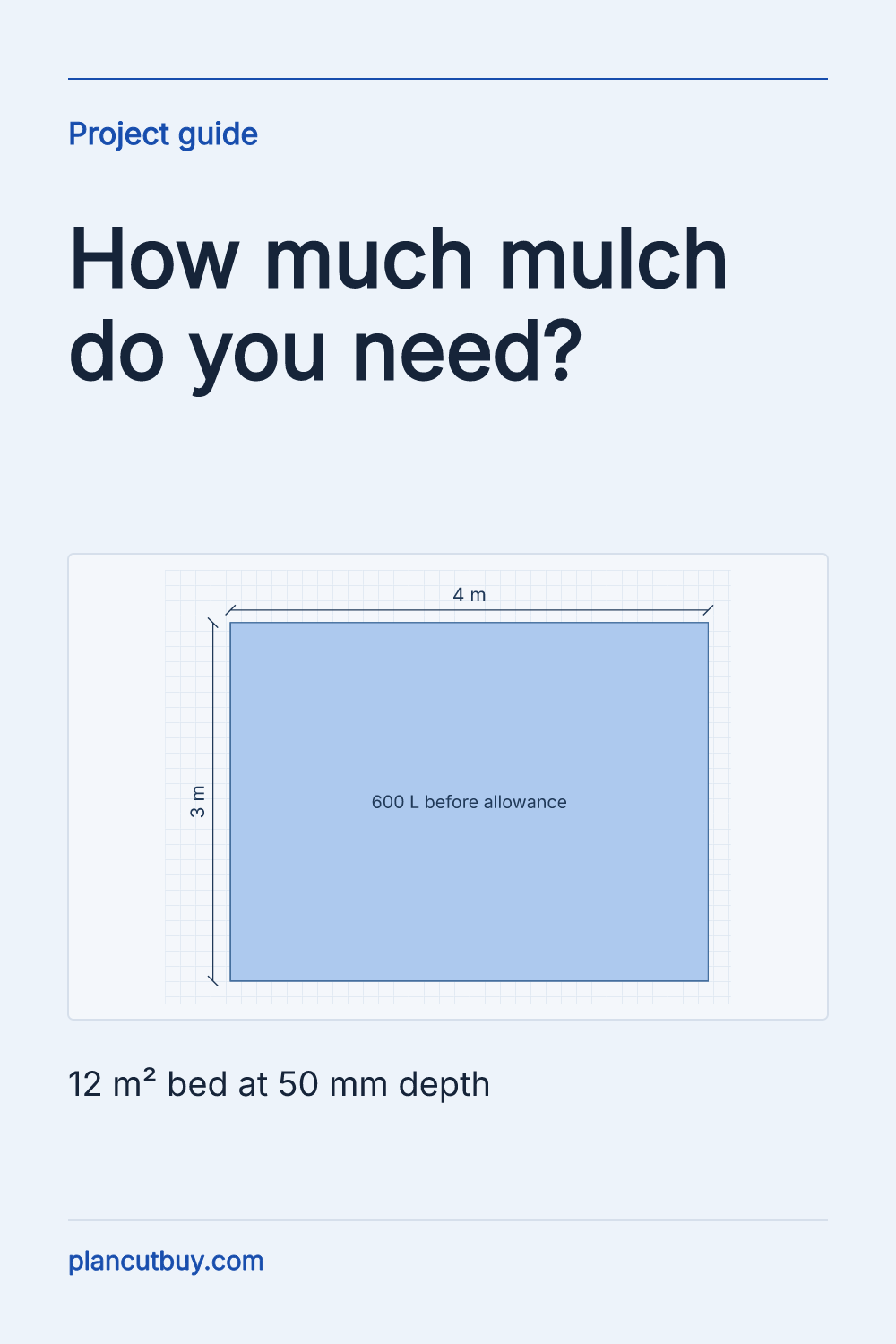
Measure the surface you want to cover and multiply by the depth you plan to add. That gives you a volume, which you can convert to litres, cubic feet or cubic yards before you choose bags or bulk delivery. Beds, tree rings and paths can each need a different depth, so check how much material is already there and decide what the new layer needs to do. The mulch calculator adds several shapes at one depth and gives you both the volume and the bag count.
Choose the depth to add
Beds. For organic mulch on a well-drained planted bed, 2–3 in (roughly 50–75 mm) after settling is a starting range. Check the product and local growing advice. Fine material may be better in a thinner layer than coarse chips. Around small plants, keep the crowns and stems clear. When you are topping up, lift the loose material and measure what remains at several points. If the bed already has 25 mm (about 1 in) and your target is 50 mm (about 2 in), calculate a 25 mm addition. See the UF/IFAS Extension mulching guidance.
Trees. Spread a wide, even layer and leave open ground around the trunk and root flare. Measure that open portion as an exclusion. For a newly planted tree, check local guidance before covering the root ball, since a layer in the wrong place can affect where water goes. Colorado State University Extension recommends keeping mulch at least 6 in (about 150 mm) from the trunk. Depth depends on the material and site. See Mulching Trees and Shrubs.
Paths. Estimate the walking surface separately. With wood chips, choose the depth based on chip size, the firmness of the base, the edging height and how much a test patch settles when walked on. Start by spreading a small section at your proposed depth. Check whether it exposes bare spots under foot traffic or spills over the edge. Account for gates, steps and transitions before using that depth for the whole path. If the path will use decorative stone, the river rock calculator can estimate volume and convert it to weight using the density you enter. That helps when a supplier sells aggregate by weight.
Measure rectangles, rings and awkward edges
For a rectangular bed, multiply its length by its average width. When the edge bends appreciably, divide it into short sections and take several widths. Treat each roughly rectangular section on its own, and use half the base times the perpendicular height for triangular ends. For a curved path, take the length along its centreline and measure width at intervals. If the width changes sharply, estimate those parts as separate sections.
For a tree ring, measure the outer diameter across the finished mulched area and the inner diameter across the clear centre. Calculate each circular area as pi times the radius squared, then subtract the inner area from the outer. An outer diameter of 2 m and an inner diameter of 0.5 m yield about 2.95 m². At 50 mm depth, the ring takes about 147 L before any allowance. To use the mulch calculator with that ring, work out net area first and enter an equivalent rectangle, such as 2.945 m by 1 m. Use actual length measurements if the ring is irregular rather than assuming it is round.
Worked example for a rectangular bed
A bed measures 4 m by 3 m (about 13.12 ft by 9.84 ft) and needs 50 mm (about 1.97 in) of new mulch. Its area is 12 m². Multiply by 0.05 m and you get 0.60 m³, or 600 L. In imperial units that’s about 21.19 ft³ or 0.78 yd³. If you’re using feet for the area, convert inches of depth to feet by dividing by 12 before multiplying. Divide cubic feet by 27 to get cubic yards.
For this purchase, add 10% to allow for uneven ground. The allowance is 60 L, bringing the order target to 660 L, or about 0.86 yd³. At 50 L per bag, divide 660 by 50 to get 13.2 and buy 14 bags. That purchases 700 L, leaving 40 L after the planned volume and allowance. The allowance is an example choice. Check what your measurement already includes so you don’t budget twice for unevenness or settlement.
Compare bags with a bulk delivery
Work in the size the supplier actually sells. Some bag labels give litres and some give cubic feet. Compare volume per bag rather than weight when the product is sold by volume. Moisture and material type change weight, so use the supplier’s own density if a bulk quote is by weight. Ask for the minimum delivery, order increments and total delivered price. For a small top-up, bags may be easier to move and store. For a larger job, think about where a bulk load can go and how many trips you’ll make from that spot with a barrow.
If several areas take the same product at different depths, calculate each volume separately, then add them before rounding the purchase. Mark your intended depth on a few stakes before spreading. When you finish the first section, check it from the soil surface in several spots. If the job also needs soil to correct a low spot, estimate that material separately with the topsoil calculator and remeasure the mulch depth from the finished soil level.
When the delivery arrives, divide it among the beds by their calculated volumes before spreading the first one. For bags, set the planned number beside each bed and keep the rounding remainder in reserve. For loose bulk, use the same barrow and a consistent fill level to keep the proportions close. If one area comes up short, check its dimensions and depth before adding material to all the other areas.
Quick answers
Frequently asked questions
How much area does a 50 L bag of mulch cover?
At a depth of 50 mm, a 50 L bag covers 1 square metre before any allowance. Double the depth and the same bag covers half the area.
Can I enter different depths in one calculation?
Run each depth as a separate calculation. If the areas use the same product, add their volumes before rounding to whole bags or to the supplier's bulk increments.
Try the calculator
- Mulch calculator
Estimate mulch volume, bags, bulk quantity, and cost for garden areas.
- Topsoil calculator
Estimate topsoil volume, bag count, and optional mass from measured garden areas.
- River rock calculator
Estimate river rock volume, optional mass, bags, and cost for landscape areas.